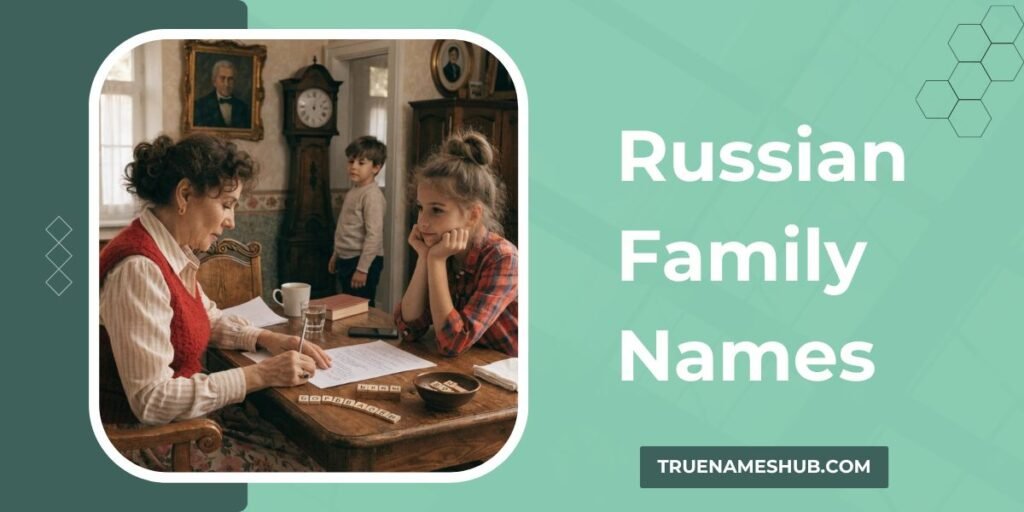
Russian family names are fascinating and full of meaning.They are an interesting part of a country’s culture, history,geography and faith.
They are more than just labels.Rooted in ancestry and shaped by language, Russian family names continue to connect modern Russians to their past in a deeply personal way.
The common endings you see — like -ov, -ev, or -in — are no accident; they reflect centuries of linguistic tradition and the stories of the families who carried them.
This article explains how russian family names are developed,what they mean,and how they still shape identity today.
What Russian Family Names Reveal
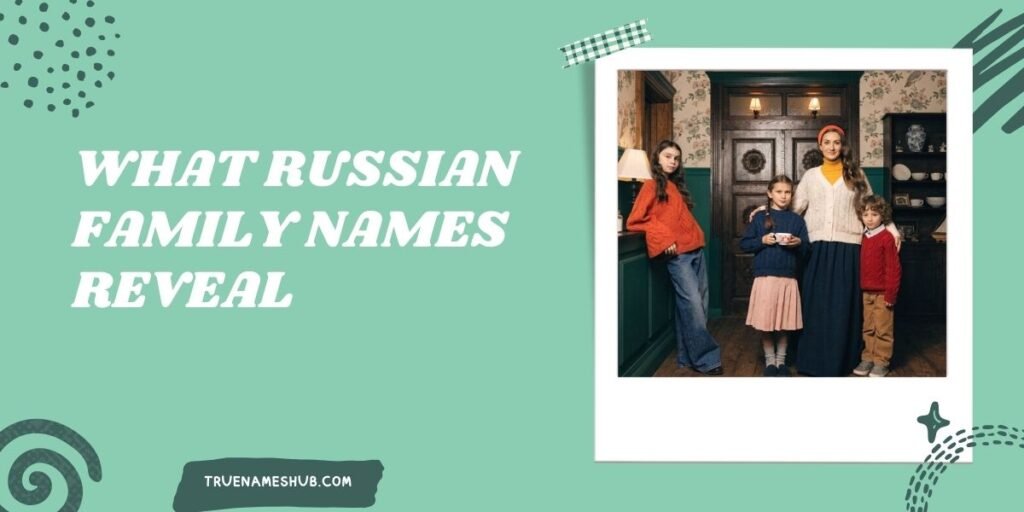
Family names in Russia tend to refer to ancestry, profession or place. And to take an example, Ivanov simply translated as the son of Ivan and the carrier is connected with his or her paternal origin.
On the same note, Kuznetsov is reminiscent of a profession, which means son of the blacksmith. Sokolov or Volkov (meaning falcon and wolf) are other surnames that are based on an animal, possibly reflecting a feature that the family values, e.g., power, bravery, or speed. Geography was also a major factor.
Titles such as Belozersky or Meschersky refer to places, which associated the family with particular locations and places.
Certain names have historical weight because of their connection to Russian nobility, e.g. Golitsyn or Dolgorukov, and provide the connection between the modern world and centuries of political, military or cultural power.
Russian Family Names Male
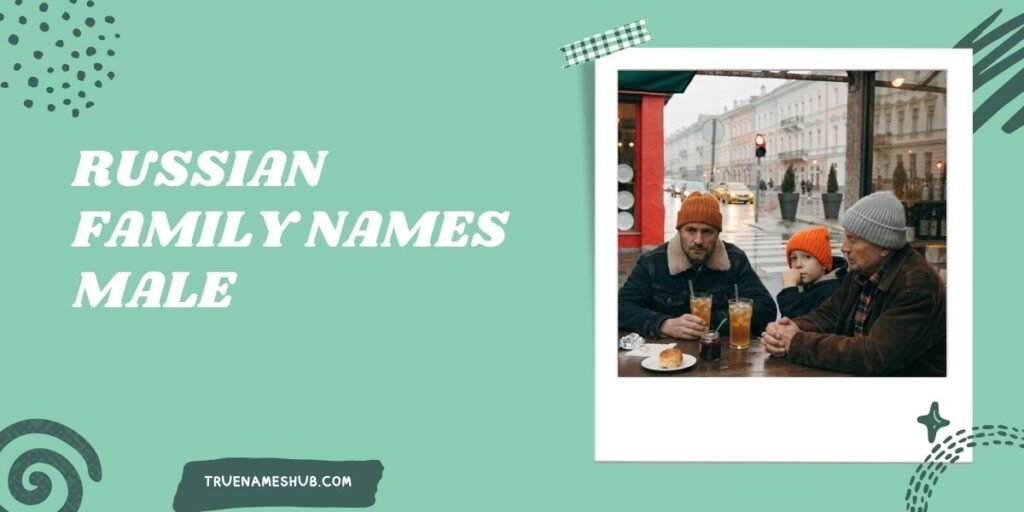
In Russian family names male, endings like -ov, -ev, and -in usually signal lineage, often tied to a father’s given name or an ancestral trade.
When reviewing archival records, I often start here because male forms tend to preserve the original root most clearly.
- Ivanov – Son of Ivan
- Petrov – Son of Pyotr
- Sidorov – Son of Sidor
- Smirnov – Calm and peaceful
- Kuznetsov – Son of blacksmith
- Popov – Son of priest
- Vasiliev – Son of Vasily
- Morozov – Son of Frost
- Volkov – Descendant of wolf
- Lebedev – Descendant of swan
- Sokolov – Descendant of falcon
- Nikolaev – Son of Nikolai
- Fedorov – Son of Fedor
- Mikhailov – Son of Mikhail
- Alexeev – Son of Alexei
- Yakovlev – Son of Yakov
- Andreev – Son of Andrei
- Stepanov – Son of Stepan
- Belyaev – Descendant of white
- Chernov – Descendant of black
- Antonov – Son of Anton
- Gavrilov – Son of Gavril
- Pavlov – Son of Pavel
- Dmitriev – Son of Dmitry
- Konstantinov – Son of Konstantin
- Romanov – Son of Roman
- Sergeev – Son of Sergey
- Matveev – Son of Matvei
- Grigoriev – Son of Grigory
- Bogdanov – Son of Bogdan
- Nikiforov – Son of Nikifor
- Timofeev – Son of Timofey
- Yuriev – Son of Yuri
- Markov – Son of Mark
- Vladimirov – Son of Vladimir
- Evseev – Son of Evsey
- Gerasimov – Son of Gerasim
- Ignatov – Son of Ignat
- Filippov – Son of Filipp
- Romanovsky – Of Roman region
Russian Names Generator
Generate traditional, modern, and unique Russian names for boys, girls, or full names instantly.
Russian Family Names Female
Russian family names female typically add an “a” to the male version, reflecting grammatical gender rather than a change in heritage.
This small shift carries major cultural meaning and remains standard in passports, academic records, and legal documents.
- Ivanova – Daughter of Ivan
- Petrova – Daughter of Pyotr
- Sidorova – Daughter of Sidor
- Smirnova – Calmandpeaceful
- Kuznetsova – Daughter of blacksmith
- Popova – Daughter of priest
- Vasilieva – Daughter of Vasily
- Morozova – Daughter of Frost
- Volkova – Descendant of wolf
- Lebedeva – Descendant of swan
- Sokolova – Descendant of falcon
- Nikolaeva – Daughter of Nikolai
- Fedorova – Daughter of Fedor
- Mikhailova – Daughter of Mikhail
- Alexeeva – Daughter of Alexei
- Yakovleva – Daughter of Yakov
- Andreeva – Daughter of Andrei
- Stepanova – Daughter of Stepan
- Belyaeva – Descendant of white
- Chernova – Descendant of black
- Antonova – Daughter of Anton
- Gavrilova – Daughter of Gavril
- Pavlova – Daughter of Pavel
- Dmitrieva – Daughter of Dmitry
- Konstantinova – Daughter of Konstantin
- Romanova – Daughter of Roman
- Sergeeva – Daughter of Sergey
- Matveeva – Daughter of Matvei
- Grigorieva – Daughter of Grigory
- Bogdanova – Daughter of Bogdan
- Nikiforova – Daughter of Nikifor
- Timofeeva – Daughter of Timofey
- Yurieva – Daughter of Yuri
- Markova – Daughter of Mark
- Vladimirova – Daughter of Vladimir
- Evseeva – Daughter of Evsey
- Gerasimova – Daughter of Gerasim
- Ignatova – Daughter of Ignat
- Filippova – Daughter of Filipp
- Romanovskaya – Of Roman region
Russian Noble Family Names
Many Russian noble family names developed through land grants, military rank, or state service, marking social status in imperial Russia. These surnames were carefully recorded, which makes them more traceable in historical research.
- Romanov – Descendants of Roman, ruling dynasty
- Rurikovich – Descendants of Rurik, founders of Russian state
- Golitsyn – Prominent princely family, derived from “golitsa” meaning bald or bare
- Dolgorukov – “Long-armed,” symbolizing influence and reach
- Shuisky – Named after the town of Shuya, noble rulers
- Obolensky – Descendants of the Obolensky princes
- Bagration – Georgian-Russian royal family, military leaders
- Trubetskoy – Old princely family, known for diplomacy
- Yusupov – Wealthy and influential aristocrats
- Vorontsov – Powerful statesmen, “forester” origin
- Sheremetev – Nobility known for military and cultural contributions
- Gagarin – Old princely family, “watchful”
- Repnin – Military leaders, derived from “repa” (turnip)
- Panin – Influential politicians, derived from “pan” meaning lord
- Khovansky – Ancient princely family, linked to Kievan Rus
- Beloselsky – “White axes,” noble lineage
- Belozersky – Princes of White Lake region
- Meshchersky – Rulers of Meshchera lands
- Suvorov – Famous military commanders, derived from “sword”
- Tcherkassky – Descendants of Circassian princes
- Vorontsov-Dashkov – Merged noble houses with high influence
- Khvostov – Derived from “khvost” (tail), indicating lineage
- Lvov – Family of lions, noble and brave
- Kropotkin – Old aristocratic family, intellectual and political influence
- Meschersky – Regional rulers, connected to Meshchera region
- Trubetskoy-Romanov – Branch of combined princely houses
- Shakhovskoy – Descendants of Rurikids, rulers of towns
- Kantemirov – Military leaders with princely heritage
- Tolstoy – “Thick,” signifying importance and wealth
- Baryatinsky – Ancient noble family, warriors and diplomats
- Golovin – Nobility with military and state roles
- Meshchersky-Kropotkin – Branch of noble families
- Yusupov-Mamontov – Merged wealth and influence
- Obolensky-Dolgorukov – Combined princely lineages
- Vorontsov-Kastalsky – Influential merged aristocratic family
- Sheremetev-Panov – Noble family known for cultural patronage
- Gagarin-Lvov – Old princely line, rulers and diplomats
- Repnin-Obolensky – Military and administrative leaders
- Khovansky-Suvorov – Merged families with historical influence
- Tcherkassky-Bagration – Royal connections to Georgian and Circassian lines
Russian Royal Family Names
Russian royal family names were linked to ruling dynasties and political authority, shaping national identity across centuries. Their influence extended beyond family lines into governance, diplomacy, and cultural legacy.
- Romanov – Main ruling dynasty of Russia (1613–1917)
- HolsteinGottorp – Branch of Romanovs from German ducal lineage
- Mikhailovich – Descendants of Tsar Mikhail I
- Alexandrovich – Descendants of Tsar Alexander I
- Nikolaevich – Descendants of Tsar Nicholas I
- Pavlovich – Descendants of Tsar Paul I
- Peterovich – Descendants of Tsar Peter I (the Great)
- Fedorovich – Descendants of Tsar Feodor I
- Ivanovich – Descendants of Tsar Ivan IV (the Terrible)
- Vladimirovich – Princes descending from Vladimir the Great
- Konstantinovich – Descendants of Grand Duke Konstantin
- Dmitrievich – Descendants of Tsar Dmitry I
- Sviatoslavovich – Descendants of Prince Sviatoslav
- Yaroslavovich – Descendants of Prince Yaroslav the Wise
- Andreevich – Descendants of Prince Andrei
- Mstislavovich – Descendants of Prince Mstislav
- Vasilievich – Descendants of Tsar Vasily IV
- Borisovich – Descendants of Tsar Boris Godunov
- Feodorovich – Another branch from Tsar Feodor I
- Alexeyevich – Descendants of Tsar Alexei Mikhailovich
- Pavelovich – Branch from Tsar Paul I
- Nicholaevich – Another branch from Tsar Nicholas I
- Sergeevich – Descendants of Grand Duke Sergei
- MikhailovichRomanov – Combined branch of Tsar Mikhail’s descendants
- AlexandrovichRomanov – Combined branch of Tsar Alexander’s descendants
- NikolaevichRomanov – Combined branch of Tsar Nicholas’s descendants
- GrandDukeRomanov – Generic title for senior male members of the dynasty
- TsarevichRomanov – Heirs apparent of the Russian throne
- GrandDuchessRomanov – Senior female members of the dynasty
- TsarinaRomanov – Queens of Russia
- HolsteinGottorpRomanov – Romanov branch from German ducal marriage
- RomanovNikolaevich – Male-line descendants of Nicholas I
- RomanovAlexandrovich – Male-line descendants of Alexander II
- RomanovMikhailovich – Male-line descendants of Michael I
- RomanovPavlovich – Male-line descendants of Paul I
- RomanovPetrovich – Male-line descendants of Peter I
- RomanovFedorovich – Male-line descendants of Feodor I
- RomanovIvanovich – Male-line descendants of Ivan IV
- RomanovVladimirovich – Male-line descendants of Vladimir the Great
- RomanovKonstantinovich – Male-line descendants of Grand Duke Konstantin
Common Russian Family Names
Common russian family names such as Ivanov or Smirnov reflect patronymic roots or everyday occupations, explaining their widespread presence today. Their frequency mirrors population growth and long-standing naming patterns.
- Abramov – Son of Abram
- Agafonov – Descendant of Agafon (good, kind)
- Alekseev – Son of Aleksei
- Anisimov – Son of Anisim
- Artemyev – Son of Artemy
- Bogdanov – Son of Bogdan (given by God)
- Borisov – Son of Boris
- Cherkasov – Circassian origin
- Davydov – Son of David
- Denisov – Son of Denis
- Egorov – Son of Egor
- Frolov – Son of Frol
- Gavrilov – Son of Gavril
- Gordeev – Son of Gordey (proud)
- Ignatiev – Son of Ignat
- Ilyin – Son of Ilya
- Kirillov – Son of Kirill
- Koltsov – Ring-like, possibly jewel-related
- Kondratyev – Son of Kondrat
- Kozlov – Goat-like
- Korolev – “Kingly” or royal
- Kruglov – Round, possibly round-featured
- Kuzmin – Son of Kuzma
- Laptev – Derived from “lapta,” soft-footed or nimble
- Litvinov – Lithuanian origin
- Lukyanov – Son of Lukyan
- Marinov – Son of Marin
- Markov – Son of Mark
- Mochalov – Derived from “mochalo,” hemp worker
- Nikiforov – Son of Nikifor
- Ovchinnikov – Shepherd-like
- Pankratov – Son of Pankrat
- Pestov – Derived from pest (plague), unlucky origin
- Prokofiev – Son of Prokofy
- Rogov – Horned, possibly strong or stubborn
- Savin – Derived from Sava
- Sorokin – Magpie-like
- Streltsov – Archer-like
- Ulyanov – Son of Ulyan
- Yermakov – Son of Yermak
- Zhukov – Beetle-like, strong or enduring
Popular Russian Family Names
Popular russian family names often gain recognition through literature, public figures, and global migration, making them familiar even outside Russia. Popularity usually reflects visibility rather than noble origin.
- Abrikosov – Derived from “apricot,” fruit seller or grower
- Adamenko – Son of Adam
- Aleksandrov – Son of Alexander
- Anatoliev – Son of Anatoly
- Antipov – Son of Antip
- Arzamastsev – From the town of Arzamas
- Avdeev – Son of Avdey
- Bakulin – Derived from “bakul,” a personal name
- Baranov – Ram-like, strong or stubborn
- Bazhenov – Derived from “bazhen,” desired or lucky
- Belkin – White, fair-featured
- Belyakov – White, pale
- Bogomolov – Worshiper of God
- Bondarev – Son of a cooper (barrel maker)
- Bortnikov – Derived from “bortnik,” beekeeper
- Boykov – Strong, warrior-like
- Bykov – Bull-like, strong
- Chaykov – Tea seller
- Chesnokov – Garlic seller or grower
- Chicherin – Derived from “chicheritsa,” plant-related
- Demin – Derived from “Demyan,” a personal name
- Denisov – Son of Denis
- Dorofeev – Son of Dorofey
- Efimov – Son of Efim
- Fedoseev – Son of Fedosey
- Filippov – Son of Filipp
- Gerasimov – Son of Gerasim
- Gladkov – Smooth, gentle personality
- Golubev – Dove-like, gentle or peaceful
- Goncharov – Son of a potter
- Grachev – Derived from “grach,” rook bird
- Gurev – Derived from “gur,” possibly strong or bold
- Ignatyev – Son of Ignat
- Isakov – Son of Isak
- Kamenev – Stone-like, solid or enduring
- Kartashov – Potato grower or seller
- Khabarov – From the town of Khabarov
- Khokhlov – Derived from Ukrainian origin
- Klimov – Son of Klim
- Kochergin – Derived from “kocherga,” stove-poker worker
Old Russian Family Names
Old russian family names trace back to early settlements and oral traditions, sometimes predating formal record keeping. Studying them often reveals dialect shifts and historical spelling variations that shaped modern surnames.
- Abramovich – Son of Abram, old patronymic origin
- Alferov – Descendant of Alfer, old personal name
- Anisimovich – Son of Anisim, ancient lineage
- Alekseyevich – Son of Aleksei, noble ancestry
- Arkhipov – Son of Arkhip, old Russian family
- Babushkin – Descendant of an elder or respected person
- Baklanov – Derived from “baklan” (cormorant), fisherman’s family
- Baranovsky – Related to “baran” (ram), old rural lineage
- Baturin – Strong warrior ancestry
- Bezborodko – “Without a beard,” old noble family
- Blinov – Pancake seller or maker, old occupational surname
- Bolshakov – “Big” or important ancestor
- Borisovich – Son of Boris, old patronymic
- Brusilov – From “brus,” timber or wooden settlement
- Bunin – Derived from personal name Bunya, old lineage
- Chekhov – Derived from “Chekha,” bohemian or foreign origin
- Cherepanov – From “cherepan,” roof tile maker
- Chesnokov – Garlic grower, old family occupation
- Chizhikov – Derived from “chizh,” small bird, old nickname origin
- Dolgopolov – “Long field,” old landholding family
- Dostoevsky – From “dostoyny” (worthy), old noble family
- Dryagin – From “dryaga,” tough or hardy ancestor
- Evdokimov – Son of Evdokim, old Christian name
- Fadeyev – Son of Fadey, old Russian name
- Fedoseyev – Son of Fedosey, ancient lineage
- Golovkin – From “golova,” leader or head of a settlement
- Golitsyn – Prominent princely family, old Rurikid lineage
- Gorbatov – From “gorbaty” (hunchback), descriptive surname
- Grebnev – Derived from “greben,” ridge or comb maker
- Grigoriev – Son of Grigory, ancient patronymic
- Gromov – Thunder-like, strong family name
- Guryanov – Son of Guryan, old Russian name
- Ivanovich – Son of Ivan, common old patronymic
- Izmaylov – Descendants of Izmayl, old family name
- Karasev – Derived from “karas” (fish), occupational or nickname origin
- Khokhlov – Ukrainian origin, old migration surname
- Kireev – Son of Kir, old Russian name
- Koltsov – Derived from “kolt,” ornament or ring, old noble family
- Konstantinov – Son of Konstantin, ancient family name
- Kostylev – Derived from “kostyl,” descriptive or nickname origin
- Krutov – From “krutoy,” strong or tough ancestor
The Structure Behind Russian Naming Traditions
Russian naming traditions tend to comprise three elements:
First name
Patronymic middle name
Family surname
Patronymic is created using the first name of the father to which suffixes like -ovich or -evich (male) or -ovna or -evna (female) are added. This organization places emphasis on family attachment and respect. This naming system is still used in the form of formalities, school and official communication.
Final Takeaways: Russian Family Names
Russian family names are based on ancestry, occupation, location, and tradition. Their forms create a definite pattern of language and often narrate a family history. Common or rare, every surname bears a connection with the past.
On one hand, the Russian surname is more than just a name — it is a living documentary of culture, heritage, and family identity, preserving history through generations.
Frequently Asked Questions About Russian Family Names
Q: What are common Russian last names?
Ans: Common Russian last names include Ivanov, Smirnov, Kuznetsov, and Petrov, often derived from patronymics, occupations, or personal traits.
Q: Is Zhenya a Russian name?
Ans: Yes, Zhenya is a diminutive of Yevgeny for males and Yevgenia for females, used affectionately among family and friends.
Q: What are classic Russian names?
Ans: Classic Russian names include Ivan, Dmitry, Anna, and Maria, often rooted in Orthodox Christian tradition and historical usage.
Q: Why do Russian last names change for women?
Ans: Russian surnames change for women due to grammatical gender, e.g., Ivanov becomes Ivanova, clarifying gender in formal contexts.
Q: How can I trace the origin of a Russian last name?
Ans: Trace Russian surnames by studying the root word and suffix, using church records, census archives, and historical documents.